
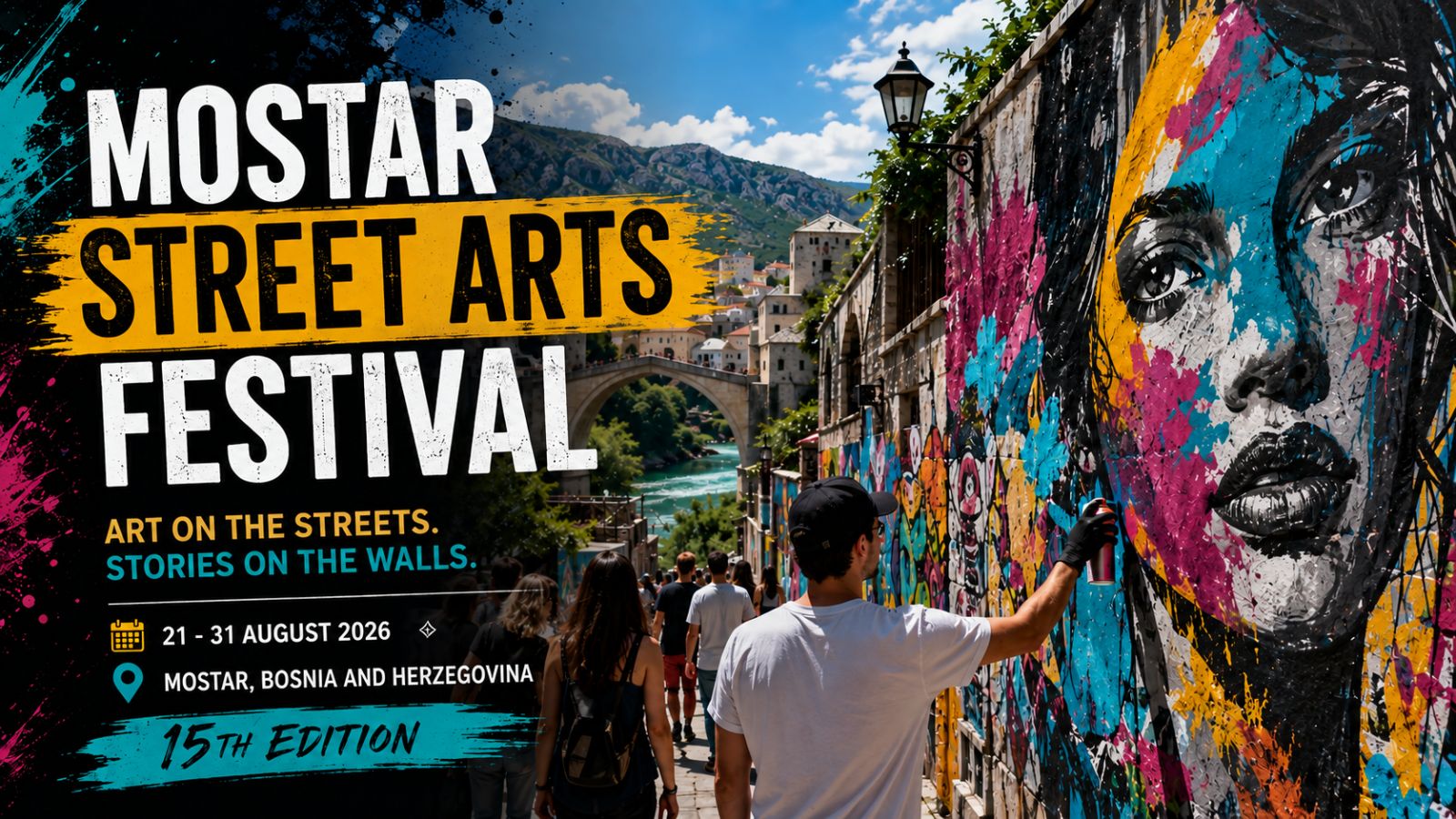
Mostar is famous for its historic architecture, the Neretva River and the Old Bridge, but during the annual Street Arts Festival the city reveals a very different side of its identity.
For ten days, walls, abandoned buildings and other urban spaces become canvases for artists from Bosnia and Herzegovina and around the world. The result is a constantly changing open-air gallery that has become an important part of Mostar’s contemporary cultural scene.
The 15th edition of the Street Arts Festival Mostar (SAFMo) takes place from 21 to 31 August 2026, bringing murals, graffiti, installations, exhibitions, music and multimedia projects to different parts of the city.
From A Youth Initiative To A Major Art Festival
The story of Mostar Street Arts Festival began in 2012, when the project emerged from a youth initiative supported by the British Council and the United World College. The original idea was simple – use art to improve neglected public spaces and give young people an opportunity to create something positive in their own city.
What started as a relatively small initiative gradually developed into an international festival.
Artists from Bosnia and Herzegovina, Croatia, Serbia, Spain, Italy, Brazil, Ecuador, the United States and many other countries have participated over the years. By 2023, more than 200 murals had been created through the festival’s activities, helping transform parts of Mostar into what has often been described as an open-air gallery.
More Than Murals
Although large murals remain the most visible part of the festival, SAFMo has never been limited to painting walls.
The programme has expanded to include graffiti, installations, paste-ups, stencil work, performances, workshops, exhibitions and other forms of contemporary public art. The organisers increasingly treat the city itself as a space for artistic experimentation.
That approach is particularly interesting for visitors because many of the works are not located inside traditional galleries. They can be discovered simply by walking through Mostar.
The Streets Become The Gallery
One of the most interesting areas for discovering Mostar’s street art is Alekse Šantića Street.
The street has a particularly complex history. During the 1990s war, it was close to a former line of separation in the city. Today, large murals and other artistic interventions have given parts of the street a completely different visual character.
Other festival works can be found around streets and neighbourhoods including Kralja Zvonimira and Kneza Domagoja, while new editions continue to introduce new locations and artistic interventions.
For visitors, this means that exploring Mostar’s street art does not require a conventional museum ticket. The city itself becomes the exhibition space.
International Artists In Mostar
The 2026 edition continues the festival’s international character.
Among this year’s participating artists are Raquel Rodrigo from Spain, Théo Haggai from France, Pijanista and Artez from Serbia, Boris Bare from Croatia, Debza from France, Boris Biberdžić from Canada and Danni Simpson from Australia, alongside artists from Bosnia and Herzegovina and other countries.
Their artistic approaches are very different.
Raquel Rodrigo brings traditional embroidery techniques into large-scale urban interventions, while Artez combines photorealism and illustration. Pijanista uses large figurative murals as a form of social commentary, while Théo Haggai works with much smaller interventions that draw attention to overlooked details of the urban environment.
This diversity is one of the festival’s greatest strengths. There is no single SAFMo style.
Mostar Artists Are Part Of The Story
The festival is not simply an international event taking place in Mostar.
Local artists have played an important role throughout its history, while SAFMo has also provided opportunities for younger artists to learn and work alongside established names.
The Street Art Mini Academy, introduced in cooperation with the Telemach Foundation, has given young people an opportunity to learn street-art techniques and develop their own creative skills.
This educational component is important because the festival is not only about creating new murals. It is also about developing a new generation of artists and encouraging young people to see public space as something they can actively shape.
The 2026 Edition: Ten Days Of Art And Culture
The 15th anniversary programme goes beyond mural production.
The festival’s OFF programme includes music, multimedia projects and exhibitions at several locations around Mostar. Among the highlights are the Mostar Mosaic – Democracy Is Fun multimedia project at MC Pavarotti, electronic music programmes and the closing exhibition dedicated to legendary graphic designer Milton Glaser at the Museum of Modern Art of the University of Mostar.
The programme therefore connects street art with music, graphic design, digital media and other contemporary cultural practices.
Why Street Arts Matters In Mostar
The importance of SAFMo goes beyond aesthetics.
Mostar has a complicated recent history, and some of the spaces transformed by the festival carry visible traces of that past. By introducing art into neglected or damaged urban spaces, the festival has created an alternative way of looking at parts of the city.
The organisers have described their approach as an attempt to create positive stories and strengthen the role of art in public space. Researchers studying Mostar have also identified the festival’s murals as an example of grassroots urban renewal and an alternative to narratives that focus exclusively on the city’s wartime divisions.
The result is not an attempt to erase the history of Mostar. Instead, the murals add another layer to it.
A Different Way To Explore Mostar
For tourists, Street Arts Festival Mostar offers something that traditional sightseeing cannot.
You can visit the Old Town and its historic landmarks in the morning, walk along the Neretva, have lunch in the city centre and then spend the afternoon discovering murals and contemporary artworks throughout Mostar.
The festival also provides a reason to explore streets that many visitors would otherwise never see.
In recent years, this aspect has become increasingly important for tourism. In 2026, the Tourist Board of the City of Mostar organised an educational programme for local tourist guides focused specifically on the festival’s murals, history and public-art interventions. The goal was to help guides incorporate the city’s street art into their tours and cultural interpretation.
When Is The Festival?
The 15th Street Arts Festival Mostar takes place from:
21-31 August 2026
Events and artworks are spread across different locations in Mostar, with the exact programme varying throughout the festival.
For visitors, the best approach is to follow the festival’s current programme and social media channels for information about artists, locations and individual events.
Why You Should See It
If you are visiting Mostar during the festival, do not limit yourself to the city’s best-known attractions.
Take some time to walk beyond the historic centre and look at the walls, abandoned buildings, small interventions and large murals that form Mostar’s contemporary artistic landscape.
Street Arts Festival Mostar has spent fifteen years changing the way public space is used and perceived. What began as a youth initiative has become an international cultural platform, while the works created through the festival remain in the city long after the artists have left.
That may be the most interesting thing about SAFMo: the festival does not simply bring art to Mostar for a few days. It leaves art behind.